
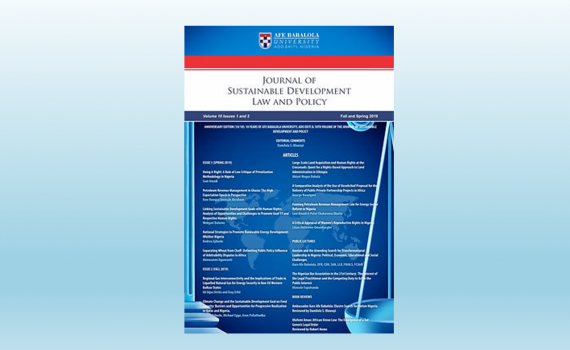
The Journal of Sustainable Development Law and Policy (JSDLP) is Nigeria’s first interdisciplinary sustainable development journal. It is published by the Institute for Oil, Gas, Energy, Environment and Sustainable Development (OGEES) at Afe Babalola University (ABUAD).
The journal bridges legal, policy, and sustainable development discourse, filling a critical gap in Africa’s scholarly landscape. As a Diamond open access (OA) journal, JSDLP does not charge fees for either authors or readers. It publishes through the ABUAD University Press and is indexed in SCOPUS, African Journals Online (AJOL), and the Directory of OA Journals (DOAJ), which attests to its quality and global visibility. Topics span environmental law, climate policy, energy governance, and socio-economic development – reflecting the breadth of the UN Sustainable Development Goals. Policymakers and civil society groups cite the journal’s content in advocacy and policy briefs, demonstrating real-world relevance.
In 2024, EIFL awarded OJEES a grant to strengthen the operations of the JSDLP by building editorial capacity through staff recruitment and training; to upgrade the journal’s digital management and publishing system and to promote knowledge exchange through workshops.
What has changed as a result of the project?
Editorial capacity is stronger, and journal management and operational processes are more efficient
Strengthened editorial team
The project enabled OJEES to hire a Research and Editorial Assistant and a Production Manager for the JSDLP, significantly strengthening the editorial team and transforming daily operations. The newly-recruited staff received intensive on-the-job training and mentorship, and by the end of the project period (October 2025), both hires had become integral to maintaining timely publication cycles.
“The impact on efficiency and quality was immediate and far-reaching,” said Professor Damilola S. Olawuyi (SAN), Editor-in-Chief of the JSDLP. “Previously delayed tasks – like author communications, peer review coordination, and copyediting – are now handled promptly. Since mid-2025, new submissions have received acknowledgment within 24 hours. The Research and Editorial Assistant is responsible for standardized quality checks, for example, plagiarism screening and reviewing manuscript formatting, and these are now routine. Senior editors report that their administrative burden has decreased, allowing more time for strategic leadership.”
The Research and Editorial Assistant also maintains an active reviewer database and mailing list, improving outreach and editorial coordination.
Improved technical infrastructure
In October 2024, JSDLP secured a service agreement with Libtech Resources and Services to install, customize, and maintain an Open Journal Systems (OJS) journal management and publishing platform for one year. Libtech also migrated journal archives and metadata going back to 2019 to the new OJS platform. By mid-2025, JSDLP had transitioned from manual, email-based journal publishing processes to a fully digital workflow.
The new platform supports automated submission tracking, peer-review and metadata integration. All JSDLP articles now receive DOIs and are enriched with standardized metadata, improving discoverability. “The new platform has reduced the average peer review time by roughly 30% and increased author satisfaction with real-time status updates,” said Prof Olawuyi.
Downloads for the June 2025 issue, the first issue published on the OJS platform, rose notably, signaling higher engagement. The OJS platform also provides usage analytics to support reporting and sustainability planning. JSDLP has created new Twitter/X and LinkedIn accounts that are rapidly drawing academics and professionals. Traffic to the journal website rose by approximately 150% in the third quarter of 2025, and the upward trend continued in 2026.
“These enhancements have boosted transparency, improved user experience, and positioned JSDLP for sustained OA publishing. The technical infrastructure and service model also serve as a replicable model for other ABUAD journals in the future,” said Prof Olawuyi.
Enhanced capacity of journal staff, editors and authors
The project enabled OJEES to organize three knowledge exchange workshops, involving staff, editors, reviewers and authors from JSDLP and other OA journals at ABUAD and in the South West region of Nigeria.
The first workshop focused on ethical issues related to journal publishing and COPE guidelines. COPE - the Committee on Publication Ethics - is a global non-profit organization dedicated to advancing excellence in publication ethics. The workshop was open to JSDLP’s editorial staff and reviewers, and editors from five other ABUAD-based journals.
Since the training, new procedures – such as mandatory ethics declarations and reviewer checklists – have been put in place at JSDLP. “Reviewers report feeling more confident and capable, crediting the training with improving their skills in delivering ethical and constructive feedback. This has elevated the journal’s reputation and internal editorial culture,” said Prof Olawuyi.
A workshop on practical skills in managing and using OJS was organized for JSDLP staff, reviewers and authors, as well as editors from five other ABUAD-based journals. Hands-on sessions helped participants master editorial workflows and metadata standards. By April 2025, many of these improved practices had been adopted into JSDLP’s routine editorial processes.
The JSDLP team shared experiences with other institutional journals in South West Nigeria. A regional workshop was attended by 300 people, including librarians, editors, researchers and authors from over 10 institutions in the region. Sessions covered journal management best practices, ethical publishing, indexing strategies, persistent identifiers, and leveraging digital tools for visibility. After the workshop participants set up a WhatsApp community to sustain engagement and peer learning.
Journal output has significantly increased
During the grant period (October 2024 - October 2025), JSDLP achieved a remarkable increase in publishing output. Before the project, the journal published two issues per year. However, in 2025 alone, four high-quality issues were published, with two more already completed for 2026, bringing the total to six issues within the grant cycle.
This expansion was driven by improved editorial workflows and staffing support made possible through the project. “It also reflects a surge in author engagement: JSDLP received over 600 article submissions during the project period – its highest ever – from contributors across 25 countries. This influx required more rigorous editorial filtering to maintain quality and uphold the journal’s scope. We published 78 articles, which is the highest annual output in the journal’s history,” said Prof Olawuyi.
Best Practice Tips and Lessons Learned
- One of the most critical lessons was the importance of securing institutional buy-in to the project early. ABUAD’s leadership not only endorsed the project from the beginning but actively supported its implementation – such as by speaking at workshops and facilitating internal approvals. This high-level backing helped secure resources, strengthen credibility, and ensure a clear sustainability path for the journal post-project.
- Embedding the journal’s operational needs into the university’s budget and leveraging existing units (such as the library and ICT department) helped ensure continuity.
- Engaging the wider university community also brought added value. By inviting students and faculty beyond the core workshop participants to key sessions such as keynote lectures, the project raised awareness and stimulated interest in research, publishing, and OA. This led to greater visibility for the journal on campus, with more students aspiring to publish or volunteer, and faculty expressing interest in contributing articles or participating in peer review.
Who Sustains the Journal After the Project?
ABUAD’s senior management, particularly through the office of the Deputy Vice Chancellor, Research, Innovation and Strategic Partnership office, has committed to sustaining the journal by covering salaries and platform costs. The journal budget is now formally integrated into the university’s research and publication framework, reinforcing long- term sustainability.
Staffing: ABUAD has formally committed to funding the core staff positions established under the grant. The Research and Editorial Assistant will now be a full-time university employee, with salary and benefits incorporated into the OGEES Institute’s annual budget from 2025/26. The part-time Copy Editor continues as a faculty service contribution, supported by a faculty development stipend. Additionally, a librarian from the University Library will periodically assist with copyediting and reference management — an in-kind commitment that further strengthens editorial capacity.
Journal Platform Maintenance: The OJS platform introduced during the project is now fully maintained by ABUAD’s ICT Directorate.The ICT team, involved during the project period, continues to manage updates and provide technical support, ensuring uninterrupted digital workflow for the journal.
Operational Costs: Routine journal operational costs, including editorial meetings and DOI registration fees, are now embedded in the OGEES Institute’s annual planning. The University Library has committed to covering DOI fees, recognizing their value in enhancing discoverability. ABUAD Press provides in-kind support for promotional printing and legal deposit copies.
“Engaging with EIFL and participating in the project’s No-Fee OA Publishing in Africa Community of Practice (CoP) gave the JSDLP team access to toolkits, templates, and international perspectives. These resources informed key decisions, such as selecting the OJS platform and adopting COPE ethics guidelines. Participation in the CoP also created opportunities to troubleshoot in real time and provided a space to share JSDLP’s own experiences with peers,” said Prof Olawuyi.
The OJEES project is one of 33 that have received grant support through a three-year project to strengthen Diamond open access publishing in Africa implemented by EIFL, AJOL (African Journals Online) and WACREN (the West and Central African Research and Education Network), with funding from Wellcome. OA-AFRICA-GRANTEE


