
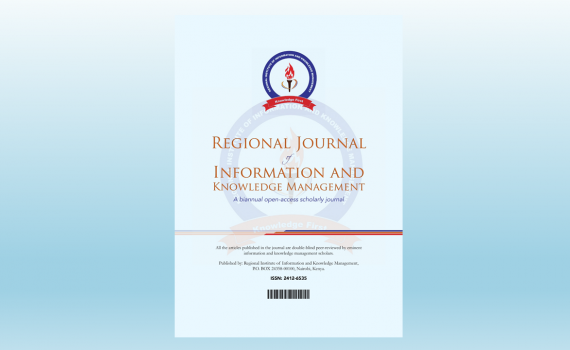
The Regional Journal of Information and Knowledge Management (RJIKM) is a peer-reviewed (no-fee) Diamond open access scholarly journal that is published biannually by the Regional Institute of Information and Knowledge Management in Kenya. Launched in 2016, the RJKM offers an authoritative platform for information and knowledge management professionals and scholars in Africa and beyond to engage, share, and learn through the publishing of quality original research.
In 2024 EIFL awarded the Regional Institute of Knowledge Management a grant for a project (October 2024 - May 2026) to enhance the quality, visibility, and long-term sustainability of the RJKIM by institutionalizing and systematizing the journal’s operations, modernizing technical infrastructure and building capacity of the Editorial Board and team, peer reviewers and authors.
“The project has transformed the journal from a mostly manual, founder-dependent initiative into a professionally managed, technologically advanced, and strategically positioned Diamond open access publication.” – Professor Tom Kwanya, Editor-in-Chief, RJIKM
What has changed as a result of the project
The journal’s operations have been institutionalized and systematized
Technical infrastructure and operational efficiency have improved
The project enabled the RJKIM to migrate its legacy website to an Open Journal Systems (OJS) journal management and publishing platform. The transition has significantly improved operational efficiency and reduced the turnaround time from manuscript submission to publication to 65 days. All manuscript processing tasks, previously managed by email, including interaction with authors and peer reviewers; editing; DOI registration, and publication are now fully automated.
The journal has also created a template making it easier for editors to format and lay out articles for publication.
Workflows have been organized and tasks allocated to editorial team members
The journal team created a workflow to organize the journal's operations and assign roles and responsibilities to different team members. The workflow details management of manuscripts from submission to publication, highlighting key functions, including initial screening, peer review, copy-editing, proofreading, publication, indexing, and post-publication promotion.
Prof Kwanya shared lessons learned and recommendations on optimizing journal workflows and processes during a webinar organized by EIFL in June 2026. See the slides and recording here.
“The complete migration to OJS ensures that all editorial processes, from submission to publication, are automated, transparent, and efficient. This systematization not only improves quality and turnaround times but also reduces the risk associated with dependence on a single individual, thereby ensuring operational continuity.” – Professor Tom Kwanya, Editor-in-Chief, RJIKM.
RJKIM policies have been revised and enhanced
The journal hosted a policy development round-table to revise existing policies and identify and fill policy gaps. Invited experts drafted comprehensive policies to ensure the quality, integrity and transparency of the journal, and to guide the editorial team, peer reviewers and authors. Policies across six key areas have been addressed:
- Archiving, Retraction, Correction, and Preservation
- Artificial Intelligence (AI) and use of Generative AI
- Manuscript submission, Editorial and peer review
- Open Access, Copyright, and Licensing
- Privacy, Conflict of Interest, Advertising, and Finance
- Publication Ethics, Plagiarism, and Research Integrity
Editorial Board was expanded
The Editorial Board was expanded to include 14 new members, bringing the total number of members to 27. These new appointments reflect a broad and internationally diverse composition. While the Board maintains a strong African identity, with members from South Africa, Kenya, Uganda, Tanzania, Nigeria, Zimbabwe, Botswana, Ghana, and Namibia, it is further enriched by experts based in Oman, the United Arab Emirates, the United Kingdom, and the United States.
“This geographical diversity provides RJIKM with a wide range of academic perspectives, research traditions, and professional networks. It enhances the journal's capacity to attract high-quality submissions from different regions, ensures balanced and contextually informed peer review, and promotes the dissemination of research that is both regionally relevant and globally significant. The Board's composition therefore reinforces RJIKM's commitment to scholarly excellence, international visibility, and the advancement of information and knowledge management research across diverse cultural and institutional contexts,” said Prof Kwanya.
Peer review was modernized through reviewer database and performance metric optimization
RJKIM implemented data-driven strategies to secure high-quality reviews and maintain publication timelines. A reviewer database was created and reviewer responsiveness and report quality tracked to prioritize the most reliable reviewers. A recognition framework has been built to formally acknowledge reviewer contributions, a useful strategy for engagement and retention. In addition, reviewer expertise has been mapped against the journal's thematic areas to improve the quality and relevance of reviewer assignments.
During the project, 48 new peer reviewers were recruited and trained, increasing the journal's reviewer pool to 162 experts.
Strategies for future sustainability have been developed
RJKIM has developed three strategies, setting out how the journal can achieve its sustainability goals:
- A financial sustainability strategy and business model. The strategy proposes diversifying sources of funding, optimising costs, improving visibility and impact, and managing expansion.
- Following a recommendation of the strategy, RJKIM has established and registered a non-profit Company Limited by Guarantee, Scholarly Nexus Foundation, to diversify resources for the journal, including mobilizing grants and establishing strategic partnerships.
- A three-year strategic work plan (2026-2028) that aims to ensure that RJIKM achieves its strategic objectives in relation to financial sustainability, visibility and indexing.
- A strategy to improve visibility and discoverability of RJKIM, including a roadmap to prepare RJKIM for indexing in major international journal databases like Scopus.
- During the project period, RJKIM took important steps to prepare for indexing by Scopus, including meeting requirements related to editorial policy, publishing standards, and overall journal governance.
- Full-text articles across all the published volumes and issues were converted to XML. The XML files are accessible alongside PDF versions on the journal website.
- The journal also acquired DOIs from Crossref and registered all current and back issues.
RJKIM was added to the EBSCO database in April 2025 and indexed by FATCAT, ZDB, SUDOC, OPENALEX, EZB, and ROAD. The journal is also receiving more submissions than before and is now listed in these recognized directories in Europe, as well as in the list of accredited journals managed by South African Department of Higher Education and Training.
RJKIM has developed new and stronger partnerships through strategic networking and alliance building
During an RJIKM networking event (July 2025) the journal negotiated and signed a partnership agreement with the Knowledge Management Practitioners Society of Kenya (KMPSK), through which the society recognized it as its official journal. This partnership provides a strategic framework for institutionalizing the journal and enhancing its sustainability and visibility.
The KMPSK has about 1,000 members. “By designating RJIKM as the official publication of KMPSK, the collaboration encourages a consistent stream of scholarly content from practitioners, researchers, and conferences. It improves peer review, editorial support, and the dissemination of African knowledge management research. The Society’s promotion of the journal within its networks will broaden readership, attract high-quality submissions, and ensure long-term relevance, establishing RJIKM as a credible and influential platform in the region,” said Prof Kwanya.
The journal has attracted the attention of renowned African scholars in the discipline of knowledge and information management who have submitted proposals for special issues. Professor Patrick Ngulube from UNISA and Dr Josiline Chigwada from Chinhoyi University of Technology, Zimbabwe, have proposed a special issue titled ‘Decolonising Innovation: Indigenous Wisdom as Catalyst for African Solutions’, which the Editorial Board has approved
“In addition to enabling the journal to address emerging trends, thereby strengthening its scholarly impact and relevance in the field, special issues boost journal sustainability by attracting targeted submissions, increasing citations, and engaging diverse research communities, ultimately improving visibility, co-funding opportunities, and the
journal's long-term relevance. They also reduce editorial costs by leveraging guest editors who manage peer review, thereby lessening the workload and resource demands on the core editorial team while maintaining quality and focus,” said Dr Azenath Ateka, Associate Editor, RJIKM.
Capacity of authors, peer reviewers and editorial board members has improved
Training programmes for authors, peer reviewers and editorial board members was developed following a training needs assessment to identify systemic and capacity-related gaps across the scholarly publishing process.
Author training: The needs assessment found that there was a clear need for targeted training to help authors understand why manuscripts are rejected and how to improve scholarly writing and submission practices.
Training (online, September 2025) was titled ‘The Autopsy of Rejected Scholarly Articles’, and attracted a total of 254 postgraduate students and early-career scholars from Kenya, Botswana, South Sudan, Ghana, Nigeria and the United Kingdom. By exploring the common reasons why scholarly articles are rejected and how to analyse and learn from rejections, the training aimed to enable emerging scholars to improve their research and publication skills, thereby increasing their chances of success in academic publishing. “Many of the trainees have submitted manuscripts to the regular and special issues of the journal, with lower desk rejection rates,” said Prof Kwanya.
In the post-training evaluation authors demonstrated improved understanding of editorial expectations, peer review processes and manuscript quality standards.
- “The session demystified peer review. I now know how to respond to reviewers instead of feeling discouraged by their comments.”
- “I realised that my problem was not research but presentation. The guidance on structure and clarity was invaluable.”
Peer reviewer training: The needs assessment found that there was a strong need to professionalize peer review through structured training focused on quality evaluation, ethics, and constructive feedback.
Online training (October 2025) for newly-recruited peer reviewers drew 48 participants. It stressed the role of peer review in upholding publication quality standards.
Post-training feedback -
- “Previously, I focused on weaknesses only. The training taught me how to balance criticism with constructive guidance.”
- “I learned how to review systematically using clear criteria instead of relying on general impressions.”
Training of newly-appointed editorial board members: The needs assessment found that board members needed structured training on governance, quality assurance, ethics, and strategic journal management.
Training (October 2025), titled ‘Strengthening Editorial Stewardship in Diamond Open Access’, covered the no-fee (Diamond) open access model, editorial roles, ethics, quality assurance, peer review, and journal visibility. Ten out of 14 new editorial board members attended the training.
The post-training evaluation found that board members strengthened their understanding of governance roles, quality assurance mechanisms, and ethical decision-making.
- “We have been struggling with reviewer management, and this training provided practical solutions.”
- “I now see my role as a steward of the journal’s credibility and reputation.”
The Regional Journal of Knowledge and Information Management project is one of 33 that have received grant support through a three-year project to strengthen Diamond open access publishing in Africa implemented by EIFL, AJOL (African Journals Online) and WACREN (the West and Central African Research and Education Network), with funding from Wellcome. OA-AFRICA-GRANTEE


